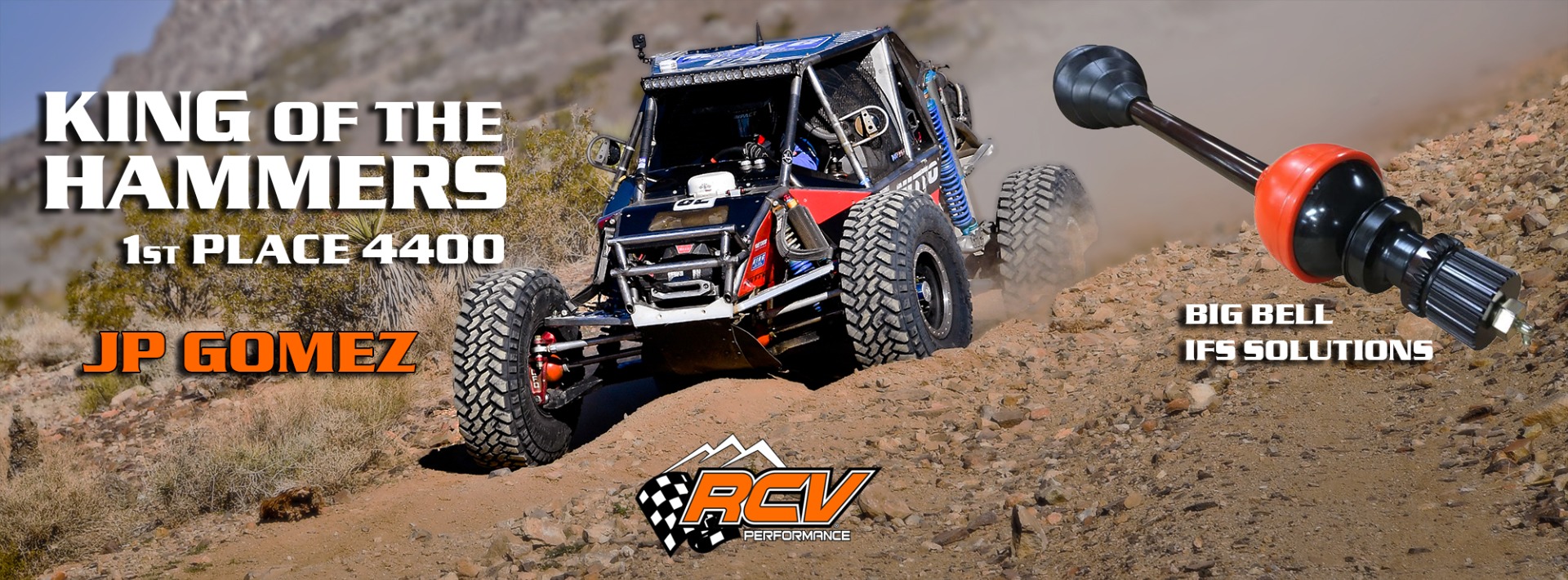
Off-Road Racing
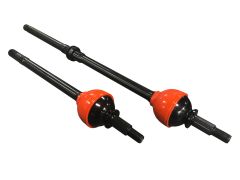
TRAXXAS #47
"This design allows the
suspension to move freely
without coming
close to binding the
RCV Performance
CV Joints."
Dirt Sports Magazine
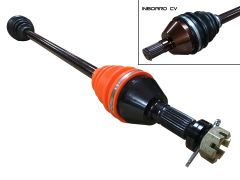
MERCEDES GWAGEN
W460 CV JOINTS
"What are these cv joints made of? I put them through the toughest trails I could find and they just don't break!"
What is a cv joint? ( Components described ) A constant velocity joint allows a rotating shaft ( half-shaft ) to transfer maximum power over high angles at a constant rotational velocity. This solves the vibration feel when using a universal joint at high angles. CV joints allow for maximum strength with minimal maintenance. There are three types of CV joints: Rzeppa, Tripod and Double Cardan.
The Rzeppa joint consists of four main components: housing, cage, race and the ball bearings. The housing is constructed with six ball tracks (represented by the red in the animation below) inside of the "bell" portion of the housing. These ball tracks allow for the ball bearings to traverse with minimal friction and minimal heat generation. The ball bearing is held between the race and the cage. There are 6 windows in the cage that are aligned with the six ball tracks of the housing. The race holds the ball bearings in place by aligning its "legs" with the web between the windows in the cage.
.
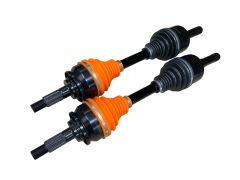
The tripod joint consists of three legs with roller bearings on the end of each leg. The three legs traverse along the tracks within the housing. The tripod style plunges in and out of the housing. Tripod joints are designed and used for inboard applications.
The double cardan joint consists of two cardan joints with a plate fusing them together. The double cardan joint offers significantly higher angles over the single cardan joint.
Whats under the orange dome?
(2715-ani 2 Click the link to download video of CV Joint Disassembly)
Why is a cv joint better than a u-joint?
The constant velocity (cv) joint has many advantage over the universal joint. First, the CV joint has greatly improved the angle at which the axle can operate before loss of power or vibration occurs. Second, the CV joint is much stronger than the U-joint because of larger for energy to be dispersed. The weak point on U-joints is the yoke. Often yokes will crack or simply break off. Joint life in both the CV-joint and the U-joint is determined by the bending angle.
What is that clicking noise in the cv joint?
The most common wear on a cv joint is within the window. Often, oem joints will have dimples wear in the window of the cage allowing the ball bearing to pop in and out of the window. The clicking is most apparent when turning because when the joint is rotating at articulation the balls are traversing the ball track at a high rate.
What does binding mean?
Do I have to re-grease my RCV Performance cv joints?